The Geometry of a Fragile Peace: Ceasefire, Conflict, and the Calculus of a Fractured World
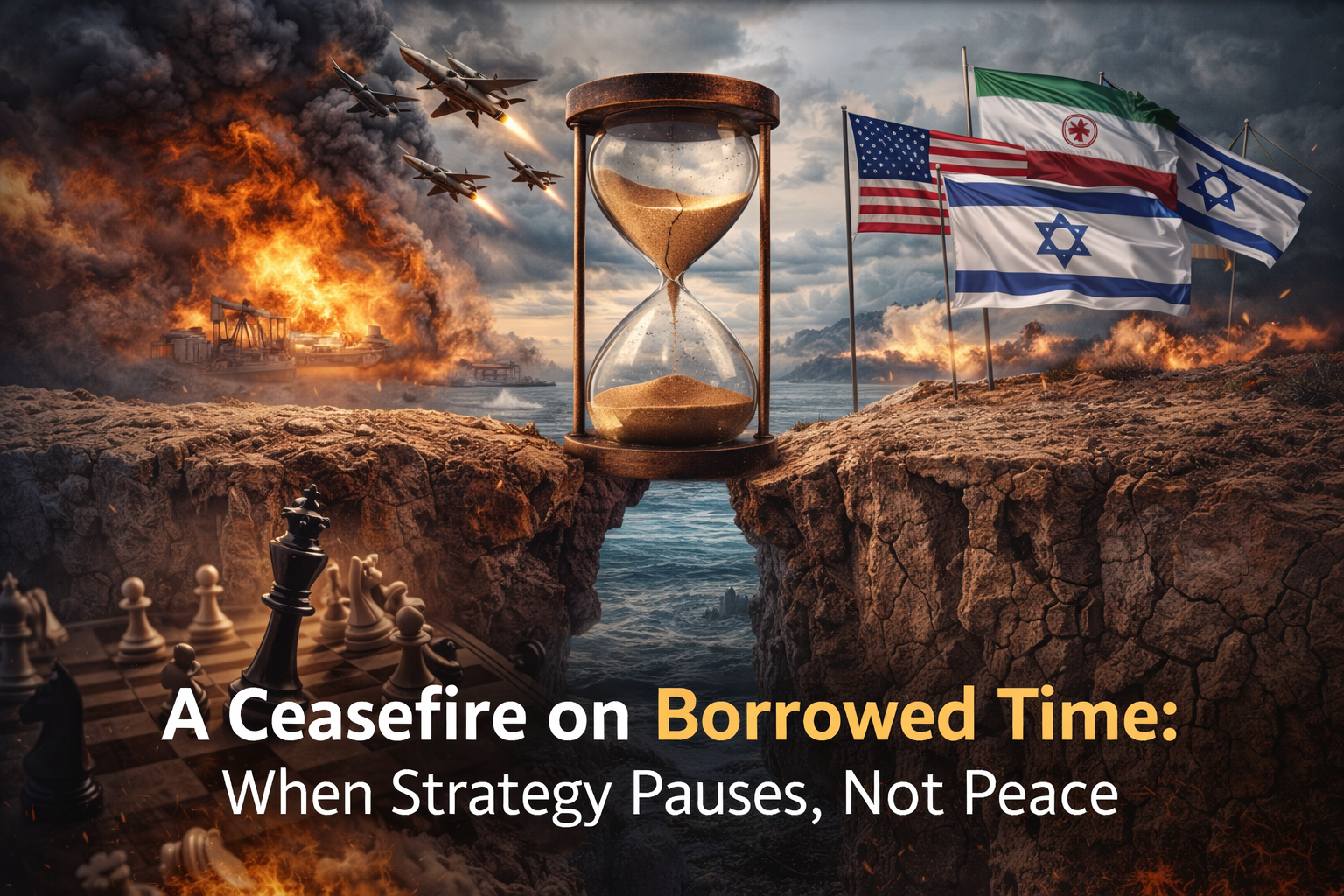
A Ceasefire on Borrowed Time: When Strategy Pauses, Not Peace
In the grand chessboard of global affairs, wars are rarely checkmates—they are prolonged middlegames, layered with feints, sacrifices, and uneasy pauses. The recent ceasefire involving Iran, Israel, and the diplomatic shadow play of the United States is not a conclusion but a punctuation mark—an ellipsis in a narrative still unfolding. It is a moment where the guns fall silent, but the tremors continue to echo across economies, alliances, and global consciousness.
At its core, this ceasefire—reportedly facilitated through high-stakes negotiations and conditional assurances around the Strait of Hormuz—reveals a deeper paradox: peace, in today’s world, is often engineered not out of resolution but out of exhaustion. The agreement for a temporary halt, coupled with Iran’s indication of allowing safe maritime passage, underscores a delicate equilibrium where strategic restraint coexists with latent hostility. It is diplomacy walking on eggshells over a minefield.
The Strait of Hormuz, through which nearly one-fifth of the world’s oil supply transits, transforms this regional conflict into a global economic event. Energy markets, ever sensitive to geopolitical whispers, responded with immediate volatility. Oil prices, as reported across financial platforms, oscillated sharply—not merely on the reality of conflict, but on the perception of its trajectory. This underscores a fundamental truth of modern economics: markets trade on expectations as much as on events.
From a macroeconomic perspective, the implications are both immediate and systemic. The International Monetary Fund (IMF) has warned that sustained geopolitical fragmentation could erode global output by up to 1% annually over the long term, a seemingly modest figure that translates into trillions of dollars in lost economic potential. Europe, already flirting with stagnation, faces renewed inflationary pressures as energy costs surge. Meanwhile, emerging economies—India included—find themselves navigating a precarious balancing act between growth aspirations and external vulnerabilities. Currency depreciation, widening current account deficits, and fiscal pressures become the silent casualties of distant conflicts.
Yet, the economic narrative is only one strand in this intricate tapestry. Politically, the ceasefire reflects an evolving architecture of global power—one that is increasingly multipolar, transactional, and fluid. The United States’ role in brokering the ceasefire signals its enduring influence, but also highlights a shift from unilateral dominance to negotiated relevance. Washington is no longer the sole conductor of the global orchestra; it is now one among several instrumentalists, harmonizing where possible, improvising where necessary.
For Iran, the ceasefire represents a calibrated assertion of agency. By signalling conditional cooperation—particularly regarding the Strait of Hormuz—it positions itself as both a disruptor and a gatekeeper. Israel, on the other hand, continues to operate within a framework of existential security, where strategic pauses are tactical, not transformative. The interplay of these positions reveals a region where peace is provisional and strategy is perpetual.
International reactions, as captured across global media, further illuminate the layered nature of this moment. European leaders have welcomed the ceasefire with cautious optimism, wary of its fragility. Asian economies, deeply intertwined with energy imports, view the development through a pragmatic lens—relief tempered by vigilance. The global response, in essence, mirrors the ceasefire itself: hopeful, yet hedged.
Trade and commerce, the lifeblood of globalization, find themselves navigating these uncertain waters with increasing complexity. The conflict has already led to a spike in shipping insurance premiums in the Gulf region, a tangible manifestation of risk translating into cost. Supply chains, still recovering from pandemic-induced disruptions, face renewed stress. According to the World Trade Organization (WTO), geopolitical tensions can reduce trade volumes in affected regions by up to 10–12%, a statistic that transforms abstract conflict into measurable economic friction.
Moreover, the ceasefire underscores a broader shift in global trade philosophy—from efficiency to resilience. Nations are rethinking dependencies, diversifying supply chains, and investing in strategic autonomy. This recalibration, while necessary, comes at a cost: higher production expenses, fragmented markets, and a departure from the seamless globalization of previous decades. The world is no longer optimizing for cost alone; it is optimizing for survival.
From an international relations perspective, this episode serves as a masterclass in contemporary diplomacy. It highlights the importance of backchannel negotiations, the role of intermediary states, and the increasing significance of non-state actors. It also underscores the limitations of traditional frameworks in addressing modern conflicts, which are often hybrid in nature—blending military, economic, cyber, and informational dimensions.
There is also a profound educational takeaway embedded within this moment. For students and practitioners alike, the ceasefire offers a living laboratory to understand the interconnectedness of global systems. It demonstrates how a regional conflict can cascade into global economic shifts, how political decisions reverberate through trade networks, and how perception can shape reality in financial markets. It is a reminder that in today’s world, silos are illusions; everything is interconnected.
Equally imperative is the human dimension, often overshadowed by strategic narratives. While policymakers debate terms and timelines, civilians grapple with uncertainty, displacement, and disruption. The ceasefire, while halting immediate violence, does not erase the scars of conflict. It merely pauses their deepening. This duality—between geopolitical strategy and human experience—demands a more holistic approach to conflict resolution, one that integrates humanitarian considerations with strategic imperatives.
Technologically, the conflict also reflects the evolving nature of warfare. Information flows, cyber capabilities, and media narratives play a critical role in shaping both domestic and international perceptions. In this sense, the battlefield extends beyond physical terrain into digital ecosystems, where narratives can influence outcomes as decisively as military manoeuvres.
In conclusion, the ceasefire between Iran, Israel, and the broader constellation of global actors is not an isolated instance - it is a microcosm of the contemporary world order. It reveals a system characterized by interdependence and fragility, by cooperation and competition, by hope and hesitation. It is a reminder that peace, in today’s context, is not a destination but a dynamic process—one that requires constant negotiation, adaptation, and vigilance.
The world, as it stands, is a tightly wound spring—compressed by competing interests, yet capable of resilience. The ceasefire offers a momentary release, but the underlying tensions remain. For those who seek to understand, navigate, and shape this world, the lesson is clear: read the pauses as carefully as the actions, for in those silences lie the true signals of what comes next.
References:
- The Hindu. Iran-Israel-US conflict live updates, April 9, 2026. [Link]
- Reuters. Trump agrees to two-week ceasefire; Hormuz passage discussions, April 8, 2026. [Link]
- The New York Times. Global reactions to Iran ceasefire, April 8, 2026. [Link]
- CNBC. Ceasefire developments and regional implications, April 8, 2026. [Link]
- International Monetary Fund (IMF). Geoeconomic Fragmentation and Global Output Loss Estimates. [Link]
- World Trade Organization (WTO). Impact of Geopolitical Tensions on Global Trade Flows. [Link]
Post a comment