The World on a Knife’s Edge: Mapping the Fractured Present and the Uncertain Future
The global scenario today resembles a vast orchestra playing without a conductor—each nation tuning its own instrument, yet the resulting symphony oscillates between harmony and dissonance. Beneath the surface of apparent resilience lies a tectonic churn: economies slowing yet surviving, geopolitics intensifying yet redefining power, and technology accelerating faster than governance can comprehend. The world, in essence, is no longer drifting—it is recalibrating.
At the heart of this recalibration lies the global economy, walking a tightrope between endurance and exhaustion. According to the United Nations’ World Economic Situation and Prospects 2026, global growth is projected at approximately 2.7%, markedly below the pre-pandemic average of 3.2%, signalling a subdued yet persistent recovery (UN Trade and Development (UNCTAD)). Similarly, UNCTAD estimates hover around 2.6% growth, reflecting a synchronized slowdown across major economies (UN Trade and Development (UNCTAD)). This is not collapse—it is deceleration, a slow-burning fatigue rather than a sudden cardiac arrest.
Yet, this fragile equilibrium is being rattled by geopolitical tremors. The ongoing conflict involving Iran has sent shockwaves through global energy markets, pushing oil prices sharply upward and igniting inflationary pressures worldwide (Reuters). Europe teeters on the brink of stagnation, with growth nearly stalling as input costs surge and consumer confidence wanes (Reuters). Even India, often the torchbearer of emerging-market optimism, faces currency volatility and slowing growth prospects under the weight of rising energy costs and external shocks (Reuters). The ghost of stagflation, once buried in the 1970s, now whispers again in policy corridors, a reminder that inflation and stagnation can coexist like twin predators (MarketWatch).
This is no coincidence. The World Economic Forum’s Global Risks Report 2026 identifies geoeconomic confrontation as the most pressing short-term risk, climbing sharply in global concern rankings (World Economic Forum). Multilateralism—the once-sturdy scaffolding of global cooperation—is eroding, replaced by strategic rivalries, protectionist policies, and fragmented alliances. As economist Gita Gopinath aptly observes, geopolitics is no longer episodic; it is structural, a permanent force shaping global policy (The Times of India).
Parallel to this geopolitical realignment is the reconfiguration of global trade and supply chains. The world is no longer chasing efficiency alone; it is chasing resilience. Nations are diversifying trade partners, reshoring industries, and securing critical resources—from semiconductors to rare earth minerals. Yet, this very diversification has paradoxically increased systemic fragility in certain sectors, as interconnected networks amplify the ripple effects of localized shocks, particularly in food and energy systems (arXiv). Globalization, once a web of opportunity, now resembles a network of vulnerabilities.
Adding another layer to this complexity is the technological revolution, particularly the rise of artificial intelligence. AI is not merely a tool; it is a geopolitical asset. Nations are competing not just for markets but for data, computational power, and algorithmic dominance. This has transformed technology into a strategic frontier, where sovereignty is measured not only in territory but in technological capability. However, this rapid advancement also fuels risks—misinformation, cyber insecurity, and ethical dilemmas—which rank among the top global concerns (World Economic Forum). The digital realm, much like the physical one, is becoming a contested battlefield.
Amid these intersecting forces, a paradox emerges: resilience amid fragility. Institutions like the IMF project global growth closer to 3.3%, suggesting that adaptive policies, technological investment, and fiscal support are cushioning the blows of uncertainty (IMF). Goldman Sachs echoes this cautious optimism, forecasting “sturdy” growth driven by policy easing and fiscal stimuli (Goldman Sachs). Yet, this resilience is uneven—concentrated in select economies while others grapple with debt, climate shocks, and structural constraints.
Indeed, the Global South is poised to drive nearly half of global growth by the end of the decade, yet it remains disproportionately exposed to external shocks and systemic inequalities (BCG Global). This asymmetry underscores a critical truth: the global economy is not a level playing field but a mosaic of divergent trajectories.
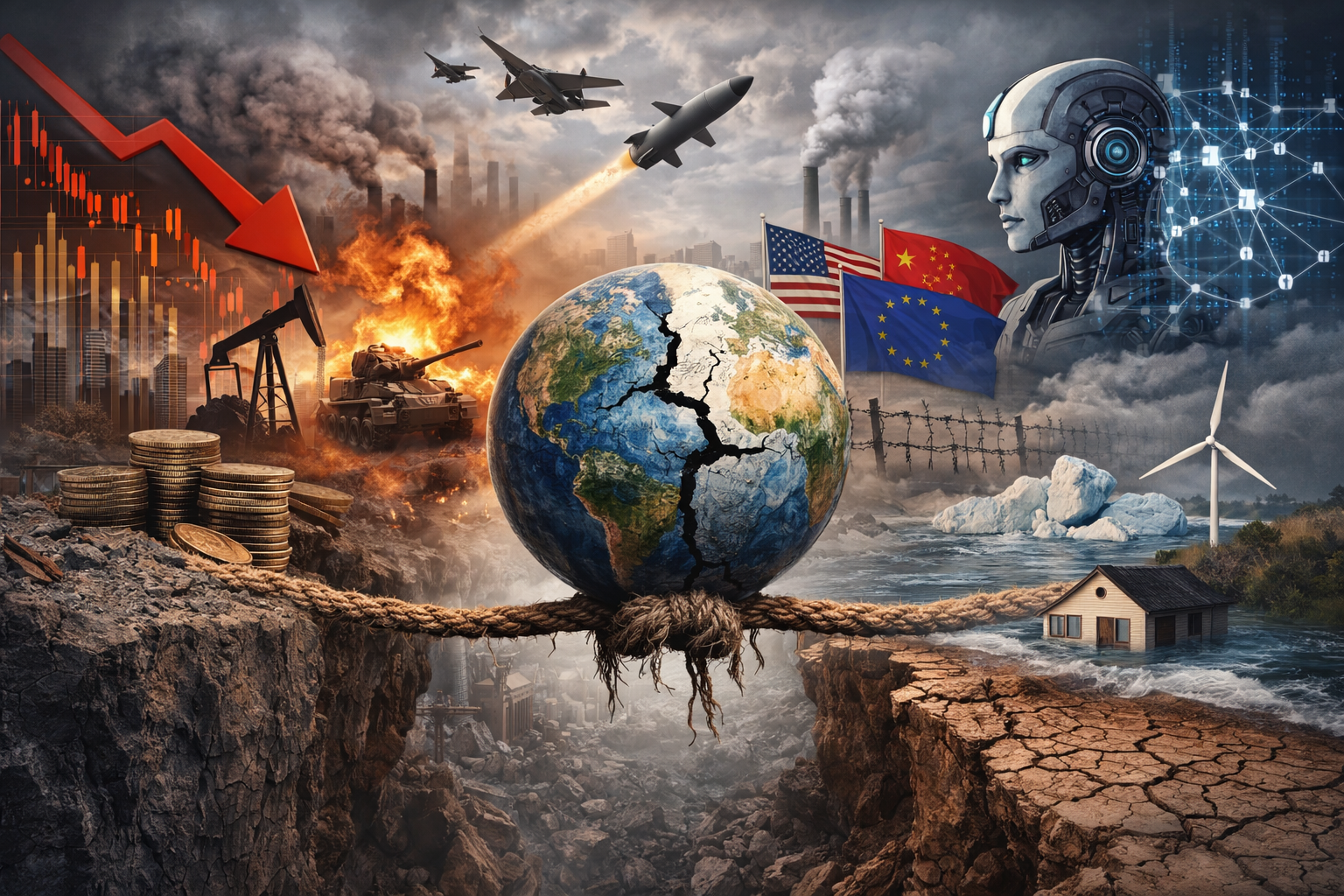
In essence, today’s global scenario is not defined by a single crisis but by converging crises—economic slowdown, geopolitical fragmentation, technological disruption, and environmental uncertainty. Each acts as both cause and consequence, weaving a complex tapestry of interdependence.
For individuals, businesses, and policymakers, the lesson is stark yet empowering: adaptability is the new currency of survival. In a world where certainty is scarce and volatility is abundant, success lies not in predicting the future but in preparing for multiple futures.
The world, then, is not merely changing—it is being rewritten. And in this unfolding narrative, those who can read between the lines of chaos will not just endure—they will lead.
References
1. United Nations. World Economic Situation and Prospects 2026. (DESA Publications)
2. UNCTAD. Global Trade Update 2026. (UN Trade and Development (UNCTAD))
3. World Economic Forum. Global Risks Report 2026. (World Economic Forum)
4. IMF. World Economic Outlook Update 2026. (IMF)
5. Goldman Sachs Research. Global Economic Forecasts 2026. (Goldman Sachs)
6. BCG. Geopolitical Forces Shaping Business 2026. (BCG Global)
7. Reuters. Global economic impact of Iran conflict. (Reuters)
8. Reuters. Eurozone economic slowdown report. (Reuters)
9. Reuters. India economic outlook amid geopolitical risks. (Reuters)
10. MarketWatch. Stagflation concerns analysis. (MarketWatch)
11. Times of India. Gita Gopinath on geopolitics. (The Times of India)
12. Academic Research on Global Trade Vulnerability. (arXiv)
edit the article content or add new blocks...
Post a comment