
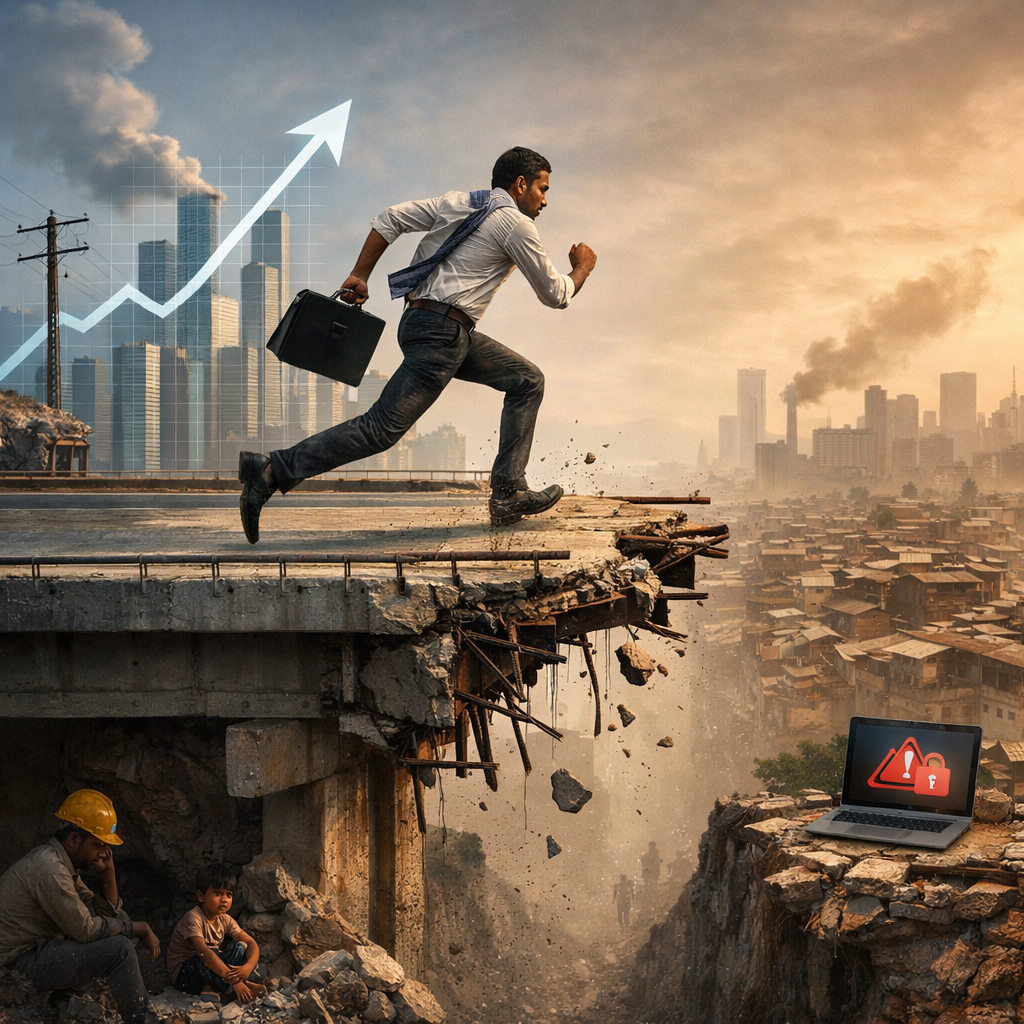
A Nation Between Speed and Stability
India’s race towards the future is real—but so is the risk of outrunning its own capacity to sustain it. (The Thinking Pulse)
India today is a paradox in motion—a nation sprinting through a marathon, chasing prosperity at a velocity that tests the endurance of its own foundations. The story of contemporary India is not merely about growth; it is about the strain beneath that growth. Beneath rising GDP numbers and digital triumphs lies a terrain marked by cybersecurity fragility, deepening inequality, and a labour market struggling to keep pace with ambition.
The question is no longer whether India is growing. The question is: at what cost—and for whom?
The Race Within a Marathon
India’s economic trajectory resembles a runner accelerating mid-race, propelled by demographic advantage, digital innovation, and global positioning. Yet, as highlighted in recent economic analyses, this acceleration is accompanied by structural bottlenecks that threaten to slow the momentum if left unaddressed.
The metaphor is telling: India is not merely running fast—it is running faster than its systems are prepared to sustain.
This imbalance manifests across three critical dimensions—political, psychological, and financial—each reinforcing the other like interlocking gears in a strained machine.
Digital Power, Fragile Foundations
India’s digital revolution is often celebrated as a global benchmark. The widespread adoption of real-time payment systems, particularly UPI, has transformed the financial landscape, enabling millions to participate in the formal economy.
Yet, this very success introduces a paradox of vulnerability.
A system built on digital centralisation creates single points of failure. Cybersecurity risks are no longer abstract—they are systemic. A breach in digital infrastructure today does not merely affect transactions; it can ripple across governance, banking, and public trust.
Economic analyses warn that cybersecurity represents one of India’s most significant emerging risks. As reliance on digital ecosystems deepens, so does exposure to cyber threats that could disrupt economic stability and national security.
In this context, India’s digital progress resembles a glass tower—impressive in height, but requiring constant vigilance to prevent fractures.
The Silent Surge of Inequality
If digitalisation is India’s visible ascent, inequality is its invisible descent.
Recent data suggests that the top 1% of India’s population controls nearly 40% of the nation’s wealth. This concentration is not merely a statistic—it is a structural imbalance that shapes access to opportunity, education, and economic mobility.
Inequality in India operates like a widening faultline beneath the surface of growth. On one side stand those benefiting from globalisation, technology, and capital accumulation. On the other are millions navigating precarious employment, rising costs, and limited upward mobility.
The psychological impact of this divide is profound.
For India’s youth—particularly those in the 15–24 age bracket—unemployment and underemployment remain persistent concerns. Even as aspirations rise, opportunities do not always follow. This mismatch breeds a quiet but growing discontent, a sense that the promise of progress is unevenly distributed.
In many ways, inequality is not just an economic issue—it is an emotional and societal pressure point.
Jobless Growth: The Paradox of Progress
India’s economy continues to expand, yet employment generation has not kept pace. This phenomenon—often described as jobless growth—represents one of the most pressing challenges facing the country.
The rise of the gig economy exemplifies this paradox.
From “10-minute delivery” services to ride-hailing platforms, new-age employment models have created opportunities—but often without stability. Workers operate without formal contracts, social security, or long-term protections. Wages remain modest, while expectations remain high.
This creates a tension between flexibility and security.
For many, the gig economy is not a choice but a necessity—a stopgap in the absence of formal employment. It reflects an economy that is innovating rapidly but absorbing labour unevenly.
The result is a workforce caught between aspiration and uncertainty—employed, yet insecure; productive, yet precarious.
The Gathering Political Undercurrents
Economic and social pressures rarely remain confined to spreadsheets—they eventually surface in the political domain.
India today is witnessing what analysts describe as a “slow-brewing political storm.” Deepening divisions—whether economic, social, or ideological—are beginning to shape public discourse and policy debates.
When inequality widens and opportunities narrow, the social contract between citizens and institutions comes under strain. Trust becomes fragile, and governance must work harder to maintain cohesion.
Political stability, therefore, is no longer just about electoral outcomes—it is about managing the underlying tensions that accompany rapid transformation.
Interconnected Pressures: A System Under Strain
What makes India’s current moment particularly complex is the interconnected nature of its challenges.
Cybersecurity risks threaten economic systems.
Economic inequality fuels social discontent.
Jobless growth undermines demographic advantage.
Political tensions amplify all of the above.
These are not isolated issues—they form a systemic loop, where each challenge reinforces the next.
India’s growth story, therefore, cannot be understood in silos. It must be viewed as a dynamic interplay of forces, where progress and pressure coexist.
The Way Forward: Balancing Speed with Stability
India’s challenge is not to slow down—but to stabilise.
This requires a multi-pronged approach:
• strengthening cybersecurity infrastructure to safeguard digital ecosystems
• addressing inequality through inclusive growth policies
• creating formal employment opportunities alongside gig economy expansion
• investing in education and skill development to align workforce capabilities with market demands
• reinforcing institutional trust through transparent and accountable governance
The goal is not merely growth, but balanced growth—a trajectory where economic expansion is matched by social stability.
A Nation at the Edge of Possibility
India stands at a defining juncture.
Its demographic dividend, technological innovation, and global positioning offer unprecedented opportunities. Yet, these opportunities come with equally significant risks.
The nation’s future will depend not on how fast it grows, but on how sustainably and inclusively it does so.
Because growth without stability is momentum without direction.
And progress without inclusion is prosperity without permanence.
In the final analysis, India’s journey is not just a race—it is a test of balance. A test of whether a nation can rise without leaving its foundations behind.
References
- 1. The Economic Times. “Economic Survey 2026: Three Possible Worlds in 2026 – What May Go Wrong.” [Link]
- 2. Vajiram & Ravi. Social Issues in India – Current Affairs Analysis. [Link]
- 3. World Inequality Database – Wealth Distribution Data (Top 1% wealth share). [Link]
- 4. International Labour Organization (ILO) – Youth Unemployment Data. [Link]
- 5. NITI Aayog Reports – Employment and Gig Economy Trends. [Link]
- 6. RBI & Government of India – Digital Payments and Cybersecurity Reports. [Link] [Link]
dit the article content or add new blocks...
Post a comment